
Analytics without cookies
Website analytics without cookies or a consent banner.
Analytics without cookies measures your traffic without setting a single cookie on a visitor’s device. No cookies means no consent banner, no consent management platform, and no visitors lost to “reject all”. MetriXs is a cookieless, GDPR-compliant analytics tool hosted in the EU, with a free plan and paid plans from €6/month.
Why run analytics without cookies?
A cookie-based analytics tool sets a cookie in the visitor’s browser so it can recognise the same person across page loads. That cookie is personal data under the GDPR and the ePrivacy Directive, which is why every site that runs one needs a consent banner asking for permission before the script even loads. Visitors who reject are excluded from your numbers, and everyone who accepts had to dismiss a pop-up first.
Analytics without cookies takes the other path. It identifies each visitor with a short-lived, salted hash of non-personal signals that is never written to the device and resets daily. No cookie, no banner, no consent friction, no lost visitors. The aggregate data is just as useful: how many people visited, where they came from, what they looked at.
Analytics without cookies vs. Google Analytics
| MetriXs (no cookies) | Google Analytics | |
|---|---|---|
| Sets cookies | No | Yes (_ga, _gid) |
| Consent banner needed | No | Yes (EU/UK) |
| Visitors who reject consent | Measured | Excluded |
| Stores IP addresses | No (daily-salted hash) | Yes |
| Cross-site user tracking | No | Yes |
| Script size | ~4 KB | ~50 KB+ (gtag.js) |
What you keep, what you give up
You keep the essentials
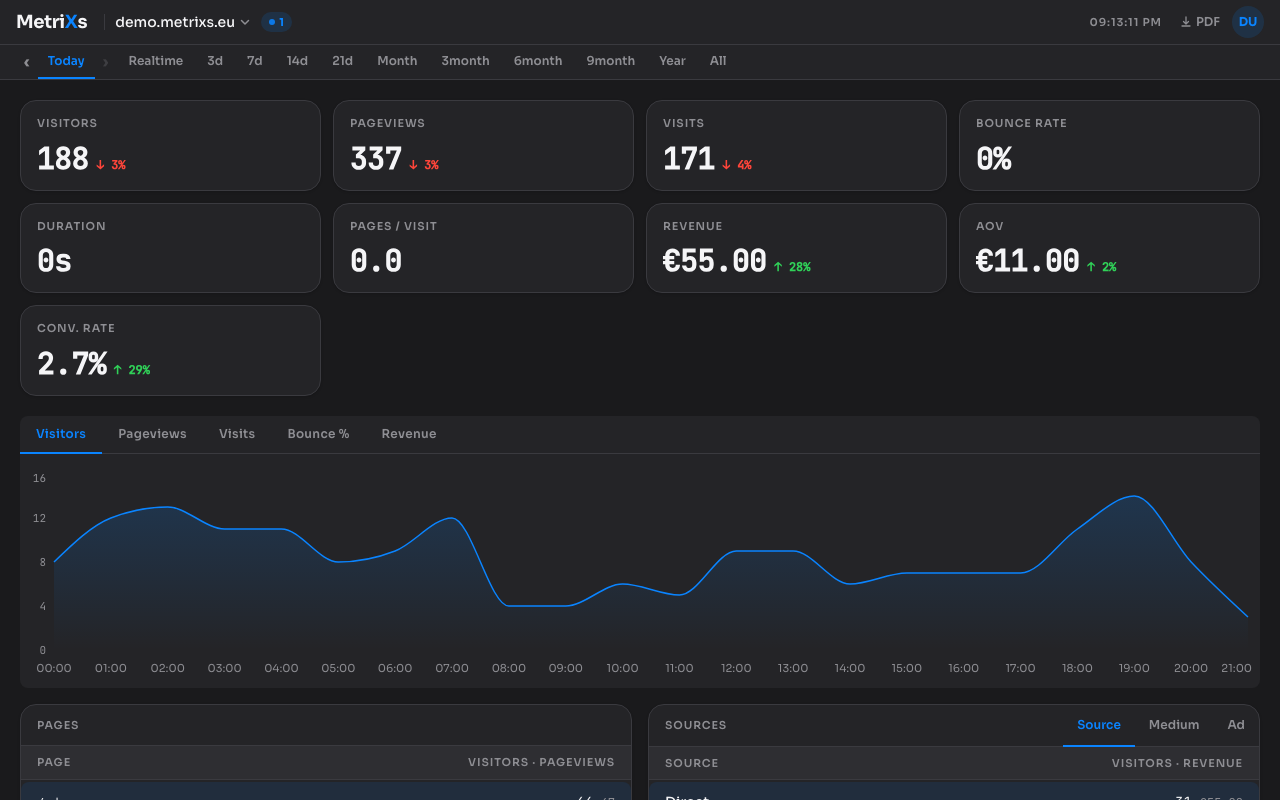
Visitors, pageviews, traffic sources, geography, devices, bounce rate, and session duration are all captured the same way. The dashboard looks the same; the data just comes from a cookieless source.
You keep your visitors
No consent banner means no “reject all” button. You measure every visitor, not just the ones who clicked accept. The consent data gap disappears.
You give up individual tracking
Cookieless analytics does not build a profile of an individual over time. No cross-site or cross-device user journeys. If you need CRM-linked attribution across months, this is not the tool.
You keep your site fast
MetriXs’ tracker is around 4 KB and sets nothing on the device. Cookie-based trackers are larger and add render-blocking weight, which hurts your Core Web Vitals.
Start with analytics without cookies
Free plan, no credit card. Paste one ~4 KB script tag and your dashboard is live. No cookies, no consent banner, no data leaving the EU.
Start free trial →Frequently asked questions
- Can you do analytics without cookies?
- Yes. A cookieless analytics tool identifies each visitor with a short-lived, salted hash of non-personal signals (IP, user agent, domain) that is never written to the visitor's device and rotates daily. You get the aggregate metrics you need, visitors, pageviews, sources, geography, without setting a single cookie.
- Do analytics without cookies need a consent banner?
- No. The ePrivacy Directive's consent requirement is triggered by setting cookies or accessing a device. A cookieless analytics tool does neither, so no cookie banner or consent management platform is needed. This is the main reason teams switch: no banner, no consent friction, no lost visitors.
- Is analytics without cookies accurate?
- For aggregate traffic metrics (visitors, pageviews, sources, devices, geography) it is as accurate as cookie-based analytics. What it does not do is track individual users across sessions and sites over time. For most businesses, aggregate trends are what they actually need.
- How do visitors get identified without cookies?
- MetriXs computes HMAC-SHA256(daily_salt, SECRET + ":" + ip + "|" + ua + "|" + domain), truncated to 32 hex characters. The salt rotates daily at midnight UTC, the raw IP is never persisted, and the hash cannot be stitched into a long-term profile. See the cookieless tracking guide for the full mechanism.
- Does analytics without cookies work with ad blockers?
- It is more resilient than cookie-based analytics. Many ad blockers and privacy extensions target known cookie-setting trackers. A small, cookieless script served from your own analytics domain is less likely to be blocked, so you see more of your real traffic.
Related
Keep reading
- Cookieless web analytics: how it works
- GDPR-compliant analytics
- Google Analytics alternative
- Cookieless tracking, explained
- Cookieless conversion tracking: forms, signups and sales
- Do you need a cookie banner for Google Analytics?
- Pricing
- MetriXs for WordPress sites
- MetriXs for PrestaShop shops
- MetriXs for Grav sites
- MetriXs for Craft CMS sites